
1. Introduction
Generative artificial intelligence refers to computational systems that produce text, images, code, audio, video, or other outputs in response to instructions and contextual inputs. The public release of conversational large language models in late 2022 brought these systems into everyday academic work and made their educational implications highly visible. Students can use them to explain concepts, generate outlines, translate material, practise questions, and obtain feedback; educators can use them to draft learning resources, develop examples, generate assessment variants, and support administrative writing. These functions create opportunities, but they also challenge familiar assumptions about authorship, assessment validity, expertise, and the relationship between effort and learning [1–4].
Early educator-focused research illustrates why responses to GenAI are rarely uniform. In a small Australian university case study, 30 staff completed a survey and eight participated in interviews. Participants expressed mixed views, reported limited institutional preparation, and raised concerns about academic integrity while also identifying potential time savings and pedagogical uses [1]. The study offers a useful contextual snapshot, but its small, institution-specific sample and early-2023 timing limit generalisation to other institutions and to the rapidly changing tools now available.
Subsequent reviews have broadened the evidence base. A scoping review of GenAI and higher-education assessment identified opportunities for feedback and self-assessment alongside challenges to integrity and assessment design [2]. A 2025 systematic review of empirical pedagogical studies similarly reported possible benefits for instructional efficiency, personalised resources, engagement, and idea generation, while highlighting inaccuracies, bias, and integrity risks [3]. A meta-analysis published in 2025 reported positive average effects across several student outcomes but found no statistically significant effect for metacognition, underlining that gains in task performance do not automatically establish independent learning [4].
The central problem is therefore not simply whether GenAI should be used, but under what conditions it supports meaningful learning, how educators can retain responsibility for academic decisions, and how institutions can develop fair and workable rules. This article addresses four questions: (RQ1) What pedagogical opportunities and risks are most consistently reported? (RQ2) How should assessment and academic integrity practices adapt? (RQ3) What support do educators and students require? and (RQ4) What institutional principles can connect innovation with educational quality and accountability?
2. Research Gap and Contribution
Existing research has rapidly expanded, but three practical gaps remain. First, findings about efficiency, engagement, and achievement are often discussed separately from questions of learner independence and long-term retention. Second, assessment discussions can become dominated by detection and misconduct, even though the validity of an assessment depends on what it measures and how students demonstrate their reasoning. Third, institutional guidance, staff development, student participation, privacy, and evaluation are frequently treated as separate workstreams rather than as parts of one implementation process [2,3,5–7].
This article contributes an integrative framework that connects tool selection to learning objectives, assessment design, human oversight, and iterative evaluation. It does not claim to report new participant data or a statistically validated intervention. Its novelty lies in organising recurring themes into an actionable model that can inform future empirical testing and institutional planning.
3. Literature Review
3.1 Educator perspectives: opportunity, uncertainty, and workload
Educators commonly evaluate GenAI through a combination of perceived usefulness, reliability, workload, professional identity, and institutional expectations. The early Australian study found that some staff used AI for teaching and administration, while others remained uncertain about its place in research and assessment [1]. More recent institutional research continues to identify questions about workforce readiness, policy, use cases, and differences in institutional capacity [6,7]. These findings suggest that adoption is not a single decision: an educator may welcome AI for generating examples while rejecting it for grading high-stakes work or handling confidential student data.
3.2 Learning support and pedagogical possibilities
GenAI can provide explanations at different levels, generate practice questions, offer examples, support brainstorming, assist language development, and help students compare alternative approaches. For educators, it may accelerate the production of draft materials and create multiple versions of a learning activity. Reviews report promising applications in feedback, personalised materials, and student engagement, but outcomes vary with task, learner, duration, and instructional context [3,4,8]. Effective use therefore requires alignment with explicit learning objectives and verification of generated content, rather than assuming that a fluent response is correct.
3.3 Assessment, authorship, and academic integrity
GenAI challenges assessments that primarily reward the production of a polished text or answer that can be generated without demonstrating the underlying learning process. A response may be well written while containing errors, unsupported claims, or reasoning that the student cannot explain. Assessment redesign can place greater emphasis on staged submissions, annotated drafts, oral explanation, application to local or course-specific cases, supervised practice, reflective commentary, and evaluation of sources. These approaches do not eliminate misconduct, but they provide richer evidence of how students reason and learn [2,5].
AI-detection scores should not be treated as conclusive proof of misconduct. Detection systems can produce false positives and may be unreliable across writing styles and language backgrounds. Institutions should use transparent procedures, human review, and opportunities for students to explain their work. Course-level rules should state whether AI is prohibited, permitted for defined purposes, or expected as part of the task, and should explain how any use must be acknowledged.
3.4 AI literacy, equity, privacy, and governance
AI literacy involves more than prompt writing. Students and staff need to understand limitations, probabilistic output, hallucinations, bias, source verification, intellectual property, data privacy, and disclosure. UNESCO recommends a human-centred approach that considers privacy, age-appropriate use, validation, and pedagogical design [5]. Equitable implementation also requires attention to accessibility, language variation, device and connectivity access, and the possibility that paid tools provide capabilities unavailable to some learners. If these conditions are ignored, AI integration may widen rather than reduce educational differences.
3.5 Emerging evidence and the need for cautious interpretation
Recent reviews offer a more developed evidence base than was available in 2023, but important limitations remain. Studies use different tools, tasks, outcome measures, and intervention durations. A meta-analysis found positive average effects for some learning outcomes, but not a statistically significant effect for metacognition [4]. A 2025 review of 93 peer-reviewed papers highlighted recurring themes including mentorship, personalised learning, creativity, higher-order thinking, and institutional support [8]. These results support experimentation, not universal claims that GenAI improves all forms of learning.
4. Methodology
4.1 Research design
This article uses a critical integrative literature-review design. It synthesises a supplied educator-perspectives case study with selected peer-reviewed reviews and policy sources published primarily between 2023 and 2026. The aim is to compare recurring themes and derive a practical conceptual framework, rather than to estimate a pooled effect or claim a fully systematic review.
4.2 Source selection and analytical procedure
Sources were selected for direct relevance to higher education, educator readiness, GenAI-supported pedagogy, assessment, academic integrity, and institutional governance. Priority was given to peer-reviewed review studies, established academic publications, and international or sector-level guidance. The synthesis proceeded in three stages: (1) extracting claims and recommendations relevant to the research questions; (2) grouping them into pedagogical opportunity, assessment and integrity, educator readiness, equity and privacy, and governance; and (3) comparing areas of convergence and tension to develop the H-GAIF framework.
4.3 Scope and limitations of method
The review is selective and integrative, not a PRISMA-reported systematic review. No new survey, interviews, experimental intervention, or original statistical analysis was conducted. The article therefore cannot establish causal effects or claim that the proposed framework has been validated. The literature is also changing quickly, and findings about specific tools may become outdated as systems are updated. These limitations should be addressed in future work through reproducible search protocols, explicit inclusion criteria, independent screening, and empirical evaluation.
5. Findings and Synthesis
5.1 GenAI is most defensible when it supports, rather than replaces, learning
The literature supports a distinction between using AI to remove avoidable friction and using it to bypass the cognitive work that an assessment is intended to develop. Generating practice questions, requesting alternative explanations, or receiving feedback on a draft can support learning when students check the response and make their own decisions. Submitting generated work without understanding or disclosure can weaken the evidence that an intended skill has been acquired. The educational question is thus not only what output the tool produces, but what thinking the learner performs around that output.
5.2 Assessment design is a core institutional response
Assessment redesign emerges as a central response because rules alone cannot preserve validity when a task is easily completed by an external system. A balanced assessment portfolio can combine supervised demonstrations of foundational knowledge with authentic projects, iterative drafts, oral questioning, reflective logs, and discipline-specific applications. AI-enabled tasks should explicitly assess skills such as verification, critique, synthesis, and responsible tool use where those skills are relevant to the course.
5.3 Educator readiness requires sustained professional learning
One-off demonstrations are unlikely to be sufficient. Professional development should be practical, discipline-sensitive, and iterative. Educators need opportunities to test tools against course outcomes, discuss acceptable use with colleagues, identify privacy risks, redesign assessments, and evaluate student work. Institutions should also recognise the time required for this work and provide shared resources, technical support, and communities of practice.
5.4 Transparency and student partnership improve implementation
Clear disclosure rules can reduce ambiguity about acceptable use. A short AI-use statement can identify the tool, purpose, and extent of assistance; an appendix may include prompts or relevant drafts when the assignment requires process evidence. Student consultation is also important: students may have different levels of access, confidence, and willingness to use AI. Co-designing guidance can reveal misunderstandings before they become disciplinary issues.
5.5 The evidence does not support simple optimism or blanket rejection
The synthesis reveals a conditional pattern: GenAI may improve efficiency and selected learning outcomes, but its value depends on task design, verification, learner expertise, and institutional context. Average gains reported in a meta-analysis should not be interpreted as proof that all learners, subjects, or outcomes benefit equally [4]. The absence of a significant metacognitive effect in that analysis is particularly relevant: completing a task with AI assistance is not the same as becoming more capable of completing it independently.
Table 1. Opportunities, risks, and practical responses
| Area | Potential value | Main risk | Recommended response |
| Learning support | Alternative explanations, practice, formative feedback | Incorrect or overconfident answers | Require verification, source checking, and student explanation |
| Teaching preparation | Draft examples, lesson ideas, differentiated materials | Generic or biased content; extra checking burden | Educator review and alignment with learning outcomes |
| Assessment | Tasks that practise critique and responsible AI use | Unclear authorship and weak evidence of independent competence | Staged work, oral defence, reflection, authentic application |
| Staff development | Shared experimentation and workflow support | Uneven confidence and limited time | Ongoing, discipline-specific professional learning |
| Equity and access | Language and accessibility support | Digital divide, privacy exposure, linguistic bias | Accessible alternatives, privacy rules, and equitable provision |
| Governance | Consistent expectations and accountability | Policies become outdated or overly restrictive | Transparent, adaptable, regularly reviewed guidance |
5.6 Proposed Human-Centred Generative AI Integration Framework (H-GAIF)
Based on the synthesis, the H-GAIF framework treats GenAI integration as a connected educational process rather than a tool-adoption checklist. It comprises six linked components: (1) identify the tool capability and its limitations; (2) define the learning objective and pedagogical role; (3) design learning activities that require student engagement; (4) align assessment with the intended competence; (5) retain human oversight for verification, inclusion, and accountability; and (6) evaluate outcomes and update guidance. The cycle is informed by student voice, evidence of learning, and institutional governance.
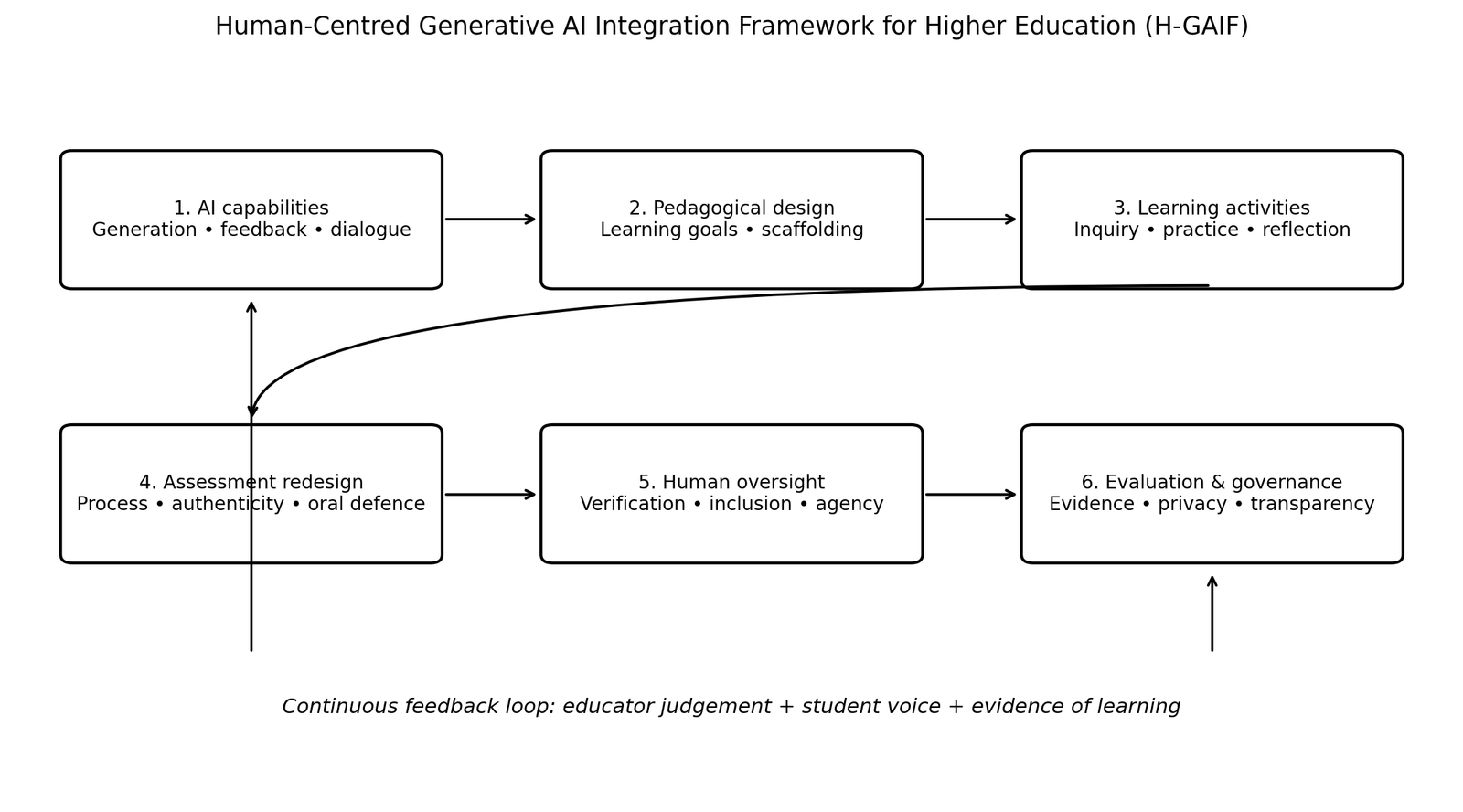
Figure 1. Human-Centred Generative AI Integration Framework (H-GAIF). Source: Author’s conceptual synthesis of the reviewed literature.
Table 2. H-GAIF components and implementation indicators
| Component | Implementation question | Possible indicator |
| Capability and limitations | What can the selected system do reliably for this task? | Educator-verified tool/task assessment |
| Pedagogical alignment | Which learning objective does AI support? | Explicit mapping to course outcomes |
| Learning activity | What must students think, practise, or decide themselves? | Evidence of student reasoning and participation |
| Assessment redesign | How will competence be demonstrated? | Draft history, applied task, oral explanation, or reflection |
| Human oversight | Who verifies accuracy, fairness, and appropriateness? | Documented review and escalation process |
| Evaluation and governance | What evidence will determine whether the approach should continue? | Learning outcomes, student feedback, equity and privacy checks |
6. Discussion
The synthesis suggests that responsible GenAI integration requires coordinated change at three levels. At the classroom level, educators need to align tool use with learning objectives and make expectations explicit. At the assessment level, institutions should strengthen the evidence of student reasoning rather than relying on a contest between generated text and detection software. At the institutional level, policy, training, privacy protections, and technical support must reinforce one another. These levels are interdependent: an institutional policy is difficult to apply if staff have not received training, and training is unlikely to change practice if assessment structures continue to reward outputs that can be generated with little learner involvement.
The H-GAIF framework adds value by linking decisions that are often separated. For example, choosing a chatbot is not the first step; the educator first identifies the intended learning outcome, determines whether AI use is pedagogically justified, specifies what students must do independently, and establishes how the resulting work will be assessed. The framework also treats evaluation as continuous. Institutions should monitor not only speed or satisfaction but also accuracy, student understanding, retention, fairness, and the distribution of benefits across student groups.
These recommendations should not be interpreted as a call to automate teaching. Human educators remain responsible for disciplinary judgement, student relationships, feedback quality, safeguarding, and decisions with significant academic consequences. GenAI can support some activities, but it cannot by itself determine what counts as meaningful learning or equitable educational practice. The appropriate balance will differ by discipline, course level, task risk, and student needs.
7. Recommendations for Practice
- Publish a concise institutional policy and require course-level statements specifying permitted, restricted, and prohibited uses of GenAI.
- Offer recurring professional development that includes practical testing, prompt and output critique, source verification, privacy, bias, and assessment redesign.
- Use a portfolio of assessment methods, including staged submissions, authentic applications, oral explanations, supervised tasks, and reflective process evidence.
- Teach students to verify factual claims and references independently; generated citations should never be accepted without checking the original source.
- Do not use AI-detection scores as sole evidence of misconduct. Use transparent procedures, contextual evidence, human review, and a fair opportunity for students to respond.
- Provide accessible alternatives and address differences in connectivity, language support, disability access, and access to paid tools.
- Prohibit uploading confidential student, staff, research, or institutional data to public AI services unless the service and use have been approved.
- Evaluate implementation using learning evidence, student and educator feedback, workload, equity, privacy incidents, and the quality of independent performance.
8. Limitations and Future Research
This article is a critical integrative review rather than a systematic review or primary empirical study. Source selection was purposive, the search and screening process was not reported as a PRISMA workflow, and the proposed framework has not been validated with educators or students. The evidence base includes studies with heterogeneous tools, disciplines, sample sizes, and outcome measures. Findings from early ChatGPT studies may not transfer directly to later systems or to institutions with different infrastructure and policies.
Future research should test H-GAIF through multi-institutional studies across disciplines and national contexts. Longitudinal designs should distinguish immediate task completion from retention, transfer, critical evaluation, and independent performance. Comparative studies could evaluate assessment portfolios with and without structured AI use, while qualitative work could examine how students interpret disclosure rules and how educators manage workload. Research should also measure differential effects by language background, disability, socioeconomic access, and prior AI literacy, with appropriate privacy and ethics safeguards.
9. Conclusion
Generative AI is neither a guaranteed route to better education nor a problem that can be solved through prohibition alone. The literature indicates potential benefits for feedback, resource creation, personalised support, and selected learning outcomes, alongside continuing concerns about accuracy, authorship, privacy, equity, and learner dependence. The most defensible response is pedagogically guided and human-centred: define the learning purpose, design activities that preserve student thinking, make AI-use expectations transparent, and retain human responsibility for assessment and consequential decisions. This article proposes the H-GAIF framework to connect tool capabilities, curriculum design, assessment, oversight, and continuous evaluation. Because the framework is conceptual, it requires empirical testing. Higher education institutions should therefore adopt flexible policies, sustained educator development, student partnership, and evidence-based review so that GenAI use strengthens rather than obscures the learning that universities are responsible for developing.