
1. Introduction
Educational institutions worldwide have increasingly adopted online and hybrid assessment models, a shift accelerated sharply during the COVID-19 pandemic and sustained afterward due to its flexibility and scalability. While online examinations reduce logistical overhead — venue booking, printed question papers, physical invigilator deployment — they simultaneously remove the single most effective deterrent against academic dishonesty: direct human observation. Students attempting an unsupervised online exam have access to unauthorized reference material, may consult other individuals, or may use a second device, none of which a conventional Learning Management System (LMS) quiz module can detect. This creates a pressing need for automated, AI-assisted proctoring systems capable of approximating the vigilance of a human invigilator without requiring one to be physically or even virtually present for every student.
Existing approaches to this problem fall broadly into three categories. First, commercial proctoring-as-a-service platforms offer robust, AI-driven monitoring — including facial recognition, gaze tracking, and room scanning — but at a per-student licensing cost that is prohibitive for smaller colleges, and they operate as closed, unmodifiable black boxes. Second, academic research prototypes, as surveyed in Section 2 of this paper, demonstrate individual detection techniques such as facial recognition, real-time object detection using YOLOv8, or audio-visual anomaly detection using CNN and LSTM architectures. These systems are valuable proofs of concept but are rarely integrated into a complete, deployable, end-to-end examination platform with question banks, grading, and reporting. Third, plain LMS quiz tools offer zero proctoring capability whatsoever, relying entirely on the honor system.
The proposed system addresses this gap by combining the practical, deployable structure of a full examination platform with a set of lightweight, computationally inexpensive proctoring signals. Built on the MERN stack, the system provides three role-based dashboards (Admin, Teacher, Student), a complete exam and question-authoring workflow, and — most centrally — a live proctoring module that runs entirely in the student’s browser during the exam. This module requests webcam access for visual presence verification, listens for browser-level events that indicate the student has left the exam window (tab switches, window blur, fullscreen exits), and blocks common cheating shortcuts such as right-click and copy/paste. Each detected event is logged with a severity weight, and these weights are aggregated in real time into a single cheating percentage per student. When this percentage — or, equivalently, the underlying violation count — crosses a configurable threshold set by the teacher, the system automatically submits the student’s exam and scores it instantly, since the current implementation focuses on auto-gradable question types (MCQ, True/False, and short-answer).
The resulting system was implemented and functionally tested end-to-end: account creation and role-based login, exam and question authoring, live violation detection during a simulated exam attempt, real-time cheating-percentage computation, automatic exam termination on threshold breach, instant score-card generation, and a teacher-facing results dashboard with per-student violation logs and optional emailed reports. All ten functional test scenarios (detailed in Section 6) passed, confirming that the architecture correctly connects the frontend proctoring logic to the backend scoring and persistence layer. The remainder of this paper surveys related work (Section 2), details the system methodology (Section 3), presents the system architecture (Section 4), discusses testing results (Section 5), and concludes with directions for future enhancement, particularly toward computer-vision-based face and gaze detection (Section 6).
2. LITERATURE SURVEY
Recent research demonstrates that online proctoring has progressed from basic authentication and manual observation toward computer-vision, behavioral-analysis, and multimodal artificial-intelligence systems.
[1] Y. Atoum, L. Chen, A. X. Liu, S. D. H. Hsu, and X. Liu — Automated Online Exam Proctoring
Atoum et al. proposed an automated online examination proctoring system based on multimedia analysis. The system uses a webcam, a wearable camera, and a microphone to monitor the student’s visual and acoustic environment. It analyzes user verification, text detection, speech, active-window behavior, gaze estimation, and phone detection before combining these features to identify suspicious examination behavior. The system demonstrates the feasibility of continuous automated proctoring, but its dependence on multiple sensing devices makes the approach more complex than a browser-only solution. This work provides an important foundation for systems that combine several examination-monitoring indicators.
[2] S. Prathish, A. Narayanan, and K. Bijlani — An Intelligent System for Online Exam Monitoring
Prathish, Narayanan, and Bijlani proposed a multimodal online examination monitoring system intended to reduce the need for continuous physical supervision. The system uses a webcam to capture video and audio along with active-window information. Facial features are used to estimate head pose, while yaw-angle variations, audio presence, and active-window changes are analyzed using a rule-based inference system. The approach demonstrates that combining several behavioral signals can improve examination monitoring, although the system requires multiple inputs and carefully defined rules.
[3] M. Côté, F. Jean, A. Branzan Albu, and D. W. Capson — Video Summarization for Remote Invigilation of Online Exams
Côté et al. developed a computer-vision-based system for automatically creating summaries of online examination videos. The system focuses on identifying abnormal student behavior using head-pose estimation and a two-state Hidden Markov Model, allowing remote proctors to review important portions of a recording instead of watching the entire examination. This approach is particularly useful for post-examination review and demonstrates the value of automatically extracting suspicious events. However, it primarily focuses on video summarization rather than integrating examination access, violation counting, and final score calculation.
[4] A. K. Pandey, S. Kumar, B. Rajendran, and B. S. Bindhumadhava — e-Parakh: Unsupervised Online Examination System
Pandey et al. proposed e-Parakh, an online examination system designed to support supervised and unsupervised remote examinations. The system includes live video and audio streaming, environmental monitoring, liveness checking, and facial comparison with the candidate’s photograph. The system also records examination information so that the evaluator can review the student’s activity during or after the examination. Its ability to operate with reduced resource requirements is particularly relevant to accessible online examinations, although continuous audio-video recording introduces additional storage and privacy considerations.
[5] D. Dilini, A. Senaratne, T. L. Yasarathna, N. Warnajith, and L. Seneviratne — Cheating Detection in Browser-based Online Exams through Eye Gaze Tracking
Dilini et al. proposed a browser-based cheating-detection mechanism using eye-gaze tracking. The system uses the built-in webcam to capture gaze movements and generates an eye-gaze dataset while students take an online examination. A One-Class Support Vector Machine is then used to detect anomalous gaze patterns that may indicate suspicious behavior. The approach is particularly relevant to browser-based examinations, but gaze deviation alone cannot establish cheating because students may naturally look away from the screen.
[6] M. A. Samir, Y. Maged, and A. Atia — Exam Cheating Detection System with Multiple-Human Pose Estimation
Samir, Maged, and Atia developed a cheating-detection system using human-pose estimation for both single-user and multiple-user examination scenarios. The system continuously evaluates head posture and hand movements from video to identify abnormal examination conditions. The authors reported detection results of approximately 92–97% in two real examination experiments. An important aspect of the approach is that the system describes detected abnormal conditions as warnings rather than automatically declaring that a student has cheated, which is useful for designing transparent violation-based proctoring systems.
[7] A. A. Turani, J. H. Alkhateeb, and A. R. A. Alsewari — Students Online Exam Proctoring: A Case Study Using 360 Degree Security Cameras
Turani, Alkhateeb, and Alsewari investigated the use of 360-degree security cameras for online examination proctoring. The approach attempts to provide a wider view of the examination environment than a conventional webcam and combines automated proctoring with biometric authentication. The study demonstrates how broader environmental visibility can improve examination monitoring. However, specialized 360-degree cameras are not readily available to every student, making a conventional webcam-based browser solution more practical for general educational use.
[8] M. Soltane and M. R. Laouar — A Smart System to Detect Cheating in the Online Exam
Soltane and Laouar proposed a fully automated online cheating-detection system using deep-learning techniques. The system incorporates face recognition, sound detection, and active-window monitoring to identify suspicious activities during an examination. CNN-based face recognition is used as one of the major components for monitoring the candidate. The multimodal design provides broader monitoring than a single detection technique, although the combination of multiple models can increase computational and implementation complexity.
[9] S. Gadkar, B. Vora, K. Chotai, S. Lakhani, and P. Katudia — Online Examination Auto-Proctoring System
Gadkar et al. proposed an automated proctoring system combining face recognition, attendance verification, talking detection, speech recognition, tab-switching detection, multiple-person detection, and no-face detection. The system uses LBPH and SVM for face recognition and incorporates facial landmarks and other computer-vision techniques for behavioral monitoring. Its inclusion of both multiple-person and no-face detection makes it particularly relevant to the proposed ProctorAI system. However, the large number of integrated components makes the architecture more complex than a lightweight Face-api.js implementation.
[10] Y. Liu, J. Ren, J. Xu, X. Bai, R. Kaur, and F. Xia — Multiple Instance Learning for Cheating Detection and Localization in Online Examinations
Liu et al. introduced CHEESE, a multiple-instance-learning framework for detecting and localizing cheating behavior in online examinations. The framework combines body posture, background information, eye gaze, head posture, and facial features captured using OpenFace. These features are analyzed using spatiotemporal modeling to identify behavioral changes in examination videos. The framework achieved a frame-level AUC of 87.58% on the Online Exam Proctoring dataset. Although it provides comprehensive behavioral analysis, its multimodal architecture is considerably more complex than the proposed browser-based approach.
[11] M. Ramzan, A. Abid, M. Bilal, K. M. Aamir, S. A. Memon, and T.-S. Chung — Effectiveness of Pre-Trained CNN Networks for Detecting Abnormal Activities in Online Exams
Ramzan et al. investigated pre-trained convolutional neural networks for identifying abnormal activities in online examinations. The research developed a dataset of cheating behaviors and extracted key frames from examination videos using motion-based frame extraction. Several deep-learning models were evaluated for classifying different categories of suspicious activity, with YOLOv5 performing better than the other evaluated approaches. While deep-learning models can provide detailed activity detection, their computational requirements may make them less suitable for lightweight browser-based deployments.
[12] H. A. Atabay and H. Hassanpour — Semi-Supervised Anomaly Detection in Electronic-Exam Proctoring Based on Skeleton Similarity
Atabay and Hassanpour proposed a semi-supervised anomaly-detection method based on skeleton similarity for electronic examination proctoring. The approach analyzes human-body structure and movement to identify behavior that differs from expected examination activity. Skeleton-based representations can reduce dependence on complete image appearance and provide useful information about posture and movement. However, reliable pose extraction is still affected by camera position, occlusion, and environmental conditions.
[13] A. H. Alkilani and M. I. Nusir — Online Exam Monitoring System Based on Factor Analysis (FA) Method
Alkilani and Nusir developed an online examination monitoring system using image preprocessing, feature extraction, and face recognition. Contrast Limited Adaptive Histogram Equalization is used to improve facial images, followed by Factor Analysis for feature extraction and classifiers such as SVM, MLP, and Logistic Regression for recognition. The system was evaluated using the AT&T and Extended Yale face datasets, with reported classification accuracies of 93% and 94% for the best configurations. The research demonstrates the usefulness of face recognition for online monitoring, although its focus is primarily identity recognition rather than browser-level examination violations.
[14] T. A. Heya, A. Serwadda, I. Griswold-Steiner, and R. Matovu — A Wearables-Driven Attack on Examination Proctoring
Heya et al. examined security weaknesses in automated examination proctoring by demonstrating how wearable devices can be used to communicate information covertly during examinations. Their attack uses coordinated wrist movements together with haptic and visual feedback to transmit answers while attempting to avoid detection by conventional proctoring mechanisms. The work demonstrates that even sophisticated visual monitoring cannot guarantee detection of every cheating strategy. This supports the need to interpret proctoring results as indicators and to combine multiple sources of examination evidence.
[15] M. Castro and S. Manoharan — Observations of Cheating Behaviours in Online Examinations and Tools for Mitigation
Castro and Manoharan analyzed cheating behaviors observed in online examinations and developed an analysis tool based on student activity logs. The system examines information from learning-management and assessment platforms to identify suspicious behaviors, including unusual answer-submission timing and potential collaboration. This work demonstrates the importance of analyzing examination logs in addition to video-based monitoring. For the proposed system, browser violations can similarly be stored as structured events and later summarized in the student’s final violation report.
[16] L.-Y. Kong, Q.-T. Zeng, X.-F. Zhu, and L.-K. Lu — Design and Realization of an Online Examination System Based on Maven Framework
Kong et al. presented a web-based online examination system developed using Java, Maven, MySQL, Bootstrap, and the SSM framework. The platform provides separate functions for students and administrators and supports examination management, question visualization, and student learning activities. The work demonstrates the architecture required for a conventional online examination platform. However, the primary focus is examination management rather than automated proctoring, leaving room for integrating real-time face monitoring and violation tracking.
[17] J. Wen and Q. Meng — Design and Implementation of Online Examination System Based on NET Framework Technology
Wen and Meng proposed a browser/server-based online examination system using the .NET framework and SQL Server. The system focuses on the development and management of online examinations and aims to improve examination efficiency compared with conventional paper-based examinations. It demonstrates the importance of a centralized web architecture for managing examination information and users. However, the system does not primarily address continuous AI-based proctoring, which is the main area extended by the proposed ProctorAI system.
[18] A. K. Sirivarshitha, K. Sravani, K. S. Priya, and V. Bhavani — An Approach for Face Detection and Face Recognition Using OpenCV and Face Recognition Libraries in Python
Sirivarshitha et al. investigated face detection and recognition using OpenCV and face-recognition libraries. The study converts facial characteristics into a representation that can be stored and compared for identity verification. The authors also identify image quality as an important challenge affecting facial-recognition performance. Since face detection and recognition are important components of online proctoring, this work provides supporting evidence for using computer vision to monitor student presence.
[19] J. Deborah L., R. Karthika, P. Vijayakumar, B. S. Rawal, and Y. Wang — Secure Online Examination System for e-Learning
Deborah et al. proposed a secure online examination system focusing on mutual authentication between the student and examination server and secure delivery of examination questions. The research demonstrates the importance of protecting examination communication and ensuring that only authenticated users can participate. Although the work focuses mainly on system security rather than AI-based behavioral monitoring, authentication is an important component of an online examination platform. The proposed ProctorAI system extends this concept by adding teacher-controlled student eligibility and examination monitoring.
[20] J. Ebron, I. G. A. Ballori, and H. A. M. Pinera — Anomaly Detection System for Possible Cheating During Online Examination
Ebron, Ballori, and Pinera proposed a real-time webcam-based anomaly-detection system for online examinations. The system uses YOLOv8 for smartphone and face detection and MediaPipe for head-pose estimation. It was trained using datasets obtained from public Roboflow sources and reported mAP@0.5 values of 97.9% for smartphones and 99.5% for faces. The approach demonstrates the effectiveness of combining object detection with head-pose analysis, but its use of relatively heavy models can increase computational requirements compared with the Face-api.js-based approach used in the proposed system.
The reviewed studies demonstrate a clear progression from basic face recognition and movement detection to sophisticated multimodal systems involving gaze, head pose, object detection, audio, and temporal machine learning. However, advanced systems frequently require substantial computational resources, additional sensors, specialized datasets, or complex model training.
At the other extreme, conventional online examination systems may provide examination management and automatic grading without meaningful real-time proctoring. The proposed project addresses this middle ground by integrating practical examination management with lightweight browser and face-monitoring mechanisms. It does not attempt to replace specialized research systems using YOLO, gaze estimation, or deep temporal models. Instead, it provides an integrated platform that can record multiple forms of suspicious activity and present them to instructors in a structured manner.
3. EXISTING SYSTEM AND LIMITATIONS
Existing online examination systems can broadly be divided into conventional examination platforms and advanced AI-powered proctoring systems. Conventional platforms mainly focus on conducting examinations digitally by providing features such as student authentication, question management, examination timers, answer submission, and automatic evaluation. These systems simplify the examination process but generally provide limited monitoring of the student’s physical environment and activities during the test. Advanced AI-powered proctoring systems attempt to overcome these limitations by incorporating technologies such as facial recognition, face detection, gaze tracking, head-pose estimation, object detection, and browser activity monitoring. Although these approaches provide more extensive monitoring, they also introduce challenges related to complexity, accuracy, privacy, and interpretation of detected events.
A. Limited Examination-Proctoring Integration
Many conventional online examination platforms primarily concentrate on assessment-related functionalities, while proctoring and suspicious-activity detection are either unavailable or implemented as separate services. As a result, examination details, monitoring events, violations, and final results may not be maintained within a single integrated workflow. Teachers may have to examine different types of information separately to understand a student’s examination behavior. A more integrated approach is therefore required in which examination access, monitoring, violation recording, answer submission, and final reporting are connected within the same system.
B. Limited Behavioral Monitoring
Basic online examination systems generally verify the student’s login and provide access to the examination but do not continuously monitor the student’s behavior. They may not detect events such as the student leaving the camera view, the presence of multiple faces in front of the camera, switching browser tabs, or exiting fullscreen mode. Consequently, an instructor may receive the student’s examination score without sufficient information about unusual activities that occurred while the examination was in progress. Continuous monitoring of relevant events can provide additional context for reviewing the examination.
C. High Complexity of Advanced AI Systems
Advanced proctoring solutions often combine several AI and deep-learning techniques to monitor different aspects of student behavior. Although combining multiple models can increase the range of detectable activities, it also increases system complexity. Such systems may require large datasets, powerful hardware, GPUs, specialized object-detection models, additional cameras, and complicated training or deployment pipelines. These requirements may make the system difficult to deploy in educational environments where students use different types of devices and have varying hardware capabilities. A lightweight browser-based approach can therefore be more practical for basic proctoring requirements.
D. False Positives and Ambiguous Events
One of the important limitations of automated proctoring is that a detected event does not necessarily prove that cheating has occurred. For example, the absence of a face from the camera may occur because the student temporarily moved away, while the detection of multiple faces may be caused by another person unintentionally entering the camera frame. Similarly, switching browser tabs or leaving fullscreen mode may have legitimate explanations depending on the examination rules. Therefore, automatically detected events should preferably be treated as indicators of suspicious activity rather than conclusive proof of cheating. Recording the individual events allows the teacher to interpret them in the context of the examination.
E. Privacy and Fairness Concerns
AI-based proctoring systems continuously process sensitive information such as facial images, student behavior, and examination activity. This creates concerns regarding student privacy, data handling, surveillance, and the appropriate use of automated decision-making. Differences in lighting conditions, camera quality, physical environments, and individual characteristics can also affect the performance of computer-vision models. Therefore, automated proctoring systems need to be designed carefully so that detected violations are not treated as unquestionable evidence and students are not unfairly affected by technical limitations.
F. Poor Post-Examination Evidence
Some examination systems primarily provide the final examination result without presenting a detailed record of the events detected during the test. In such cases, the instructor may have limited information for understanding why a particular examination was considered suspicious. Maintaining a structured violation history can provide better transparency by recording events such as face absence, multiple-face detection, and other configured examination violations. A final scorecard containing the total violation count and cheating percentage can further summarize the recorded events and make the examination report easier for the teacher to review.
G. Uncontrolled Examination Access
In some online examination systems, authentication only confirms that a user has a valid account and does not necessarily determine whether that student is authorized to participate in a particular examination. This can make examination access difficult to control when a test is intended only for a specific group of students. Providing teachers with the ability to select and authorize students for each examination gives better control over participation. The system can then verify whether a student is included in the permitted list before allowing access to the examination.
H. Lack of a Unified Violation-Based Scorecard
Another limitation of many existing systems is the absence of a simple mechanism for converting detected events into a consolidated examination report. Individual events may be recorded, but teachers may still need to manually review them to understand the overall behavior of a student. A unified scorecard can summarize the number of detected violations and calculate a corresponding cheating percentage based on the configured violation criteria. This provides the teacher with a clearer overview while still allowing the underlying events to be reviewed when necessary.
Thus, existing systems provide useful examination and proctoring capabilities, but they often involve either limited monitoring in conventional platforms or high complexity in advanced AI-based systems. The major gap is the need for a lightweight, integrated system that combines examination management with practical monitoring features, controlled student access, violation tracking, and clear post-examination reporting. The proposed system addresses this gap by integrating Face-api.js-based face detection, multiple-face and face-absence detection, examination violation tracking, teacher-selected eligible students, and a final scorecard containing violation count and cheating percentage.
4.PROPOSED SYSTEM
The system proposed in this paper is designed specifically to close the integration gap identified above. Rather than pursuing a single high-accuracy detection modality that requires GPU inference, it combines several lightweight, browser-native signals — webcam presence, tab-switch and window-blur events, fullscreen-exit detection, and copy/paste or right-click blocking — into one weighted violation-scoring pipeline that runs on standard, low-cost hosting. This detection layer is embedded directly within a complete MERN-stack examination platform that also handles role-based authentication, exam and question authoring, automatic MCQ grading, real-time cheating-percentage computation, threshold-based auto-submission, and a teacher-facing results dashboard with per-student violation logs and optional emailed reports. By prioritizing integration and deployability over any single detection technique’s raw accuracy, the proposed system offers a practical middle ground between expensive commercial proctoring services and disconnected academic research prototypes, and its modular architecture leaves clear extension points for the computer-vision and audio-analysis techniques identified in the literature to be layered in as future work.
The system provides two major user roles:
Teacher: creates examinations, configures examination rules, adds questions, selects permitted students, reviews submissions and violations, and generates reports.
Student: accesses authorized examinations, answers questions, participates under the configured proctoring rules, and submits the examination.
The examination database structure connects users with examinations, questions, submissions, violation logs, and reports.
The proposed system differs from advanced research systems by focusing on integration and practical deployment rather than developing a new deep-learning architecture.
5. Methodology
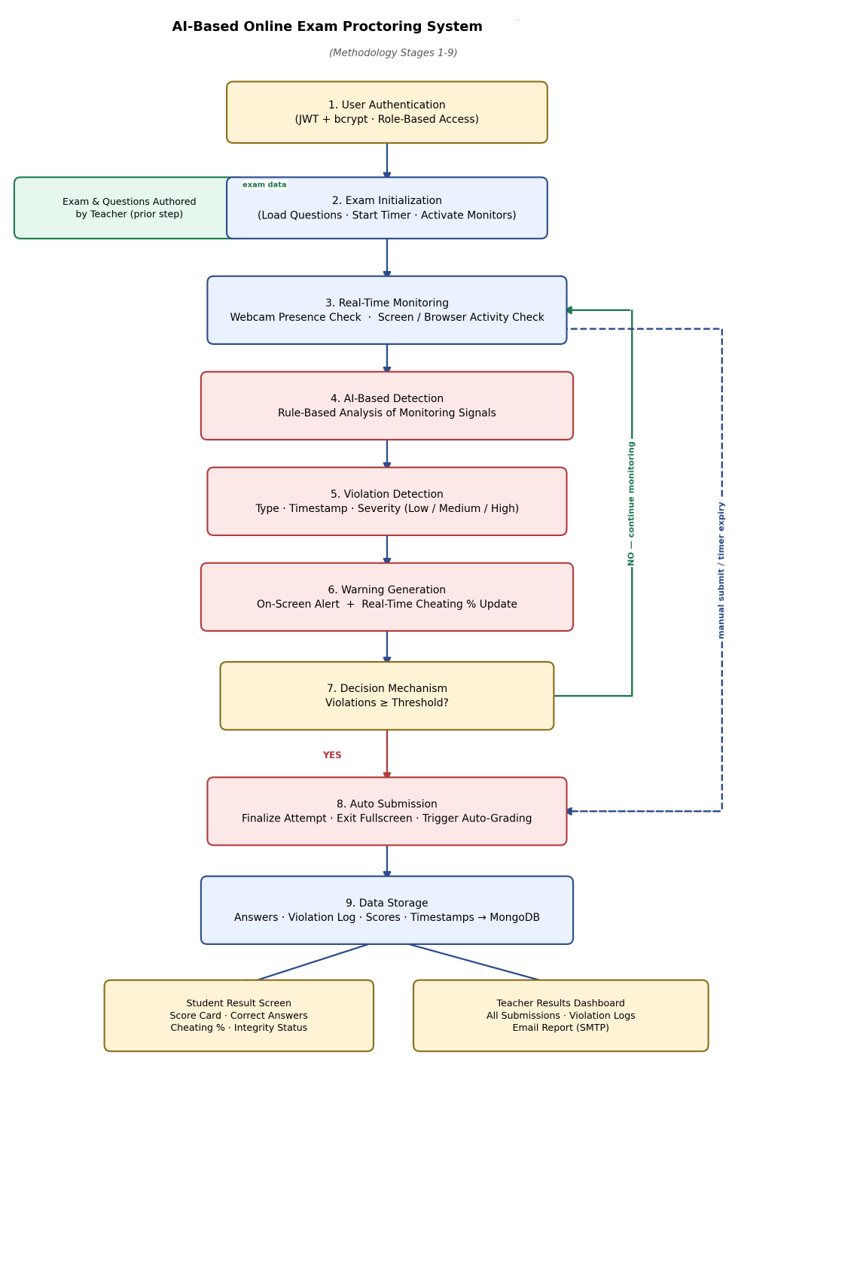
Fig 1:- Methodology/flow diagram of the proctoring system.
The system’s methodology is best understood as a sequential pipeline of nine stages, beginning the moment a user logs in and continuing until the exam attempt is finally scored and archived. Each stage builds directly on the output of the one before it, and two of the later stages loop back into the monitoring cycle so the system remains responsive to new violations for as long as the student stays within the allowed limit. Independently of this pipeline, and prior to it, a teacher has already authored the exam and its question set through the teacher dashboard; that stored exam is what stage 2 below loads for the student. Each of the nine stages is described in turn.
5.1 User Authentication
Every session begins with the student, teacher, or admin submitting their login credentials through the authentication module. The system verifies the submitted email and password against records stored in MongoDB, where every password is hashed with bcrypt at the time of registration so that plain-text passwords are never persisted. Once the credentials are verified, the server issues a signed JSON Web Token (JWT) that the browser attaches to every subsequent request, allowing the backend to identify the user and enforce role-based access control without the password being resent. The token also encodes the user’s role — Student, Teacher, or Admin — so that the correct dashboard and permitted actions are determined immediately after login, and any attempt to reach a route outside that role’s permissions is rejected before it reaches the underlying data.
5.2 Exam Initialization
Once a student selects an exam from their dashboard, the exam-initialization stage prepares the environment in which the attempt will take place. The system fetches the exam’s question set, duration, and proctoring configuration — previously authored by the teacher and stored in the database — and creates a new submission record tied to that student and exam so progress can be resumed if the browser is refreshed. A countdown timer is started based on the configured duration, and the proctoring module is activated in parallel: the browser requests webcam access, and event listeners for tab visibility, window focus, fullscreen state, and clipboard actions are registered. Only once these monitoring modules are confirmed active does the student see the first question, ensuring that no portion of the exam is ever presented without proctoring in place.
5.3 Real-Time Monitoring
With the exam underway, the system continuously monitors the student along two parallel channels for the full duration of the attempt. The first channel, webcam monitoring, keeps a live video feed visible in a small corner window, providing a continuous visual presence check and a psychological deterrent against leaving the seat or bringing another person into frame. The second channel, screen and browser monitoring, silently observes the state of the browser tab itself — whether it is currently visible, whether the page still holds fullscreen mode, and whether the window has lost focus — without interrupting the student’s ability to answer questions. Both channels run for as long as the exam is in progress, and any change of state detected on either channel is passed immediately to the detection stage that follows.
5.4 AI-Based Detection
The signals captured during real-time monitoring are interpreted by the detection layer, which decides whether a given change of state constitutes suspicious behavior worth logging. In the current implementation this layer is rule-based: it applies a fixed set of heuristics — for example, treating a hidden tab, a lost window focus, or an exited fullscreen state as behavior indicative of the student leaving the exam context — rather than a trained machine-learning model analyzing raw video frames. This design choice keeps the detection layer lightweight enough to run in real time in any student’s browser without GPU acceleration, at the cost of not yet recognizing more complex visual cues such as a second face entering the frame or the direction of the student’s gaze. The architecture is deliberately modular at this stage, so a deep-learning-based visual classifier can be substituted in later without changing any of the stages before or after it, a direction discussed further in the future scope.
5.5 Violation Detection
Once the detection layer flags a state change as suspicious, the violation-detection stage formally records it as a violation tied to the student’s active submission. Each recorded violation carries a type — tab-switch, window-blur, fullscreen-exit, right-click attempt, or copy/paste attempt — along with a timestamp and a severity level of low, medium, or high, reflecting how serious that particular behavior is considered. A fullscreen exit, for instance, is treated as high severity since it typically indicates the student has left the exam page entirely, whereas a brief window blur is treated as low severity since it can also occur accidentally. These violation records are appended to a dedicated violation log tied to the submission, building a complete, timestamped history that a teacher can review later alongside the student’s final score.
5.6 Warning Generation
Every time a new violation is recorded, the system generates a warning in two places at once. On the student’s screen, a brief on-screen notification informs them that a specific type of violation was just detected, reinforcing that the exam is being actively monitored and discouraging further attempts to leave the exam context. On the backend, the student’s cumulative violation count and a running cheating-percentage score are recalculated immediately, using the severity weights described in the previous stage, so both numbers are always current rather than being computed only at the end of the exam. This running cheating percentage is what the decision mechanism in the next stage evaluates against the teacher-configured threshold.
5.7 Decision Mechanism
After every warning is generated, the system checks the updated violation count against the threshold configured by the teacher for that specific exam. If the number of recorded violations remains below the configured limit, the decision mechanism allows the exam to continue uninterrupted, and control returns to the real-time monitoring stage to keep watching for further violations. If the violation count reaches or exceeds the configured limit, the decision mechanism triggers the auto-submission stage immediately, without waiting for the student to take any further action. This same decision point is bypassed — rather than blocked — whenever the student submits manually or the exam timer reaches zero, both of which route directly to auto-submission regardless of the current violation count.
5.8 Auto Submission
When either the violation threshold is crossed, the timer expires, or the student submits manually, the auto-submission stage takes over and finalizes the attempt. The system immediately marks the submission as closed, exits fullscreen mode if it is still active, and passes all recorded answers to the auto-grading engine, which scores every MCQ and True/False question against its stored correct answer and produces a final numeric score. No further edits to any answer are accepted once this stage begins, and if the submission was triggered specifically by the violation threshold, it is additionally flagged for teacher review so it is not mistaken for an ordinary, unflagged attempt.
5.9 Data Storage
In the final stage, every artifact produced during the exam — the student’s answers and final score, the complete violation log with timestamps and severities, the computed cheating percentage, and the submission’s status — is persisted to the MongoDB database as a permanent record. This stored data is what powers the two outputs the rest of the system depends on: the student-facing score card, which reads the final score and cheating percentage the moment the submission closes, and the teacher-facing results dashboard, which aggregates every student’s submission for an exam and allows the underlying violation log to be inspected in detail. Because this record is retained indefinitely rather than discarded after grading, it also forms the basis for the optional emailed report and for any future academic-integrity review a teacher or administrator may need to conduct.
6. System Architecture
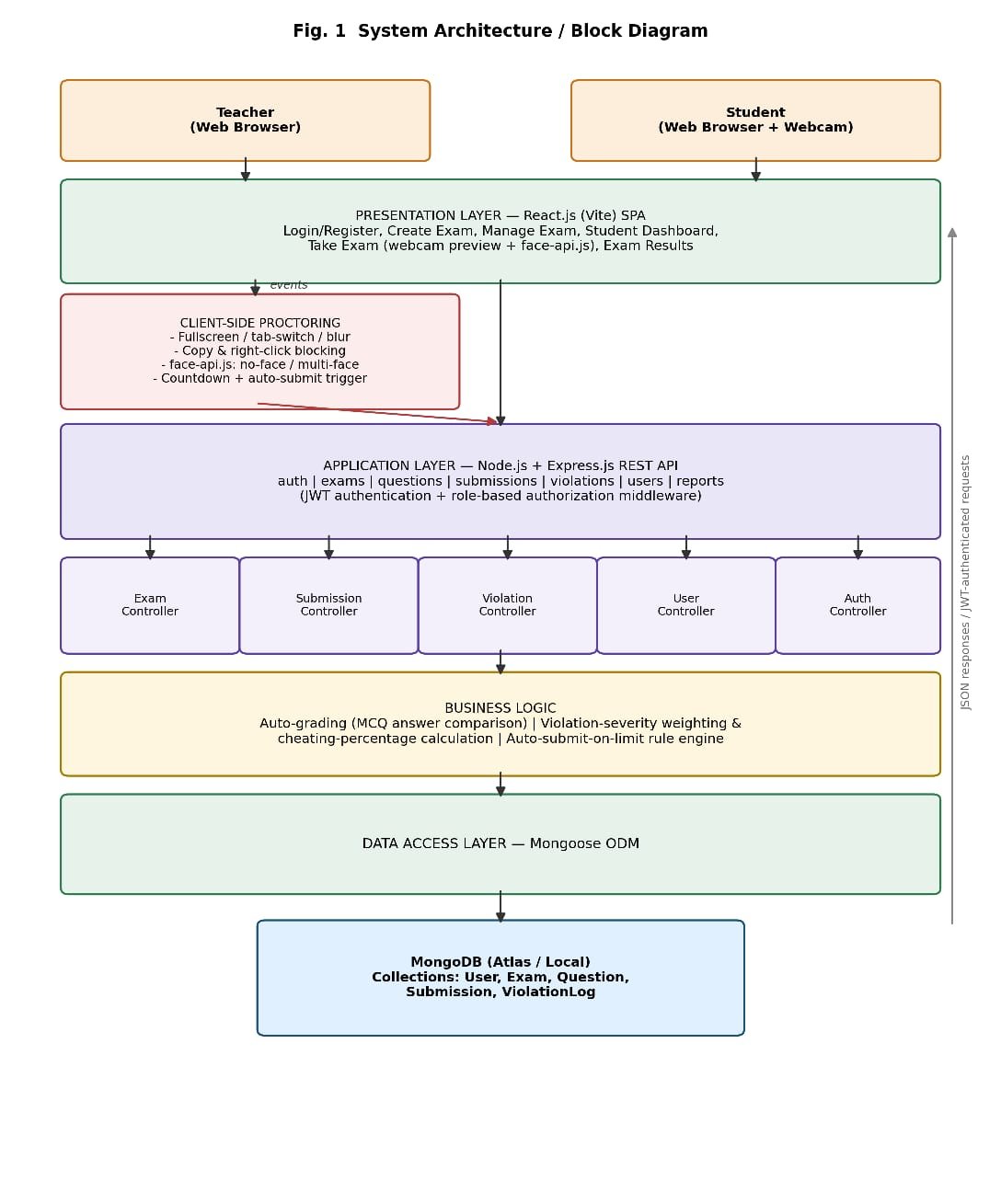
Fig 2 :- System Architecture of the proctoring system.
The system is built on a layered client-server architecture consisting of four distinct layers. The presentation layer is a React.js single-page application, built with Vite, that provides the browser-based interface for both teachers and students — including login and registration, exam creation and management, the student dashboard, the live exam-taking screen with webcam preview, and the post-submission results view. This layer communicates exclusively with the backend through a REST API, never accessing the database directly.
Below the presentation layer sits the application layer, a Node.js and Express.js server that exposes the system’s REST API across six route groups: authentication, exams, questions, submissions, violations, and users. Every incoming request first passes through JWT-based authentication middleware, which verifies the user’s identity, and for routes restricted to specific roles, a second authorization middleware checks that the authenticated user holds the required role (teacher, student, or admin) before the request is allowed to proceed to its controller.
The business logic layer is embedded within these controllers and represents the system’s core decision-making logic: automatic grading of multiple-choice answers, calculation of a running cheating-percentage score from logged violations, and the rule that determines whether an exam should be automatically submitted. Finally, the data layer uses Mongoose as an object-data-modelling layer over MongoDB, persisting five primary collections — User, Exam, Question, Submission, and ViolationLog — each defined by a schema that enforces the shape of its documents.
A typical request flows through all four layers in sequence: the browser issues an authenticated API call, the middleware verifies the request, the relevant controller executes the necessary business logic, Mongoose reads or writes the corresponding MongoDB collection, and a JSON response travels back up to update the React interface.
5. Results and Discussion
The system was functionally tested end-to-end across ten core scenarios: role-based registration and login; exam and question creation; student exam visibility within a scheduled window; tab-switch detection; fullscreen-exit detection; real-time cheating-percentage calculation; automatic exam submission once the configured violation limit was crossed; instant score-card display immediately after submission; the teacher results dashboard with per-student violation logs; and automated email report generation. All ten scenarios passed, confirming that violation events raised by the browser-level proctoring module are correctly received, weighted, and aggregated into the cheating-percentage score on the backend, and that the submission-trigger decision point correctly halts the exam and triggers automatic MCQ grading the moment the configured violation threshold is crossed, regardless of whether the trigger was a manual submit, timer expiry, or violation limit.
The student-facing score card renders immediately after both a manual and an automatic submission, showing the score, correct-answer count, violation count, and cheating percentage with a corresponding integrity status label (clean, flagged, or disqualified). On the teacher side, the results dashboard correctly aggregates all submissions for an exam and allows the per-student violation timeline to be expanded on demand. These results demonstrate that a rule-based, browser-event-driven proctoring layer can be integrated into a complete examination platform with low computational overhead and no dependency on GPU-accelerated inference, directly addressing the deployability gap identified in the literature survey.
The principal limitation observed during testing is that the current detection layer is behavioral rather than visual: the webcam feed is displayed and its presence verified, but no computer-vision model currently analyzes the video stream for facial identity, multiple faces, or gaze direction, meaning the system cannot yet detect a scenario where a second person is present off-camera or where the registered student is replaced by another individual mid-exam. Similarly, detection is confined to events observable within the browser tab, so actions taken entirely outside the browser, such as a second physical device, are not captured. These limitations are consistent with the trade-off intentionally made in the system design — favoring lightweight, broadly deployable detection over the higher computational cost of the vision-based techniques surveyed in Section 2 — and are addressed directly in the future scope below.
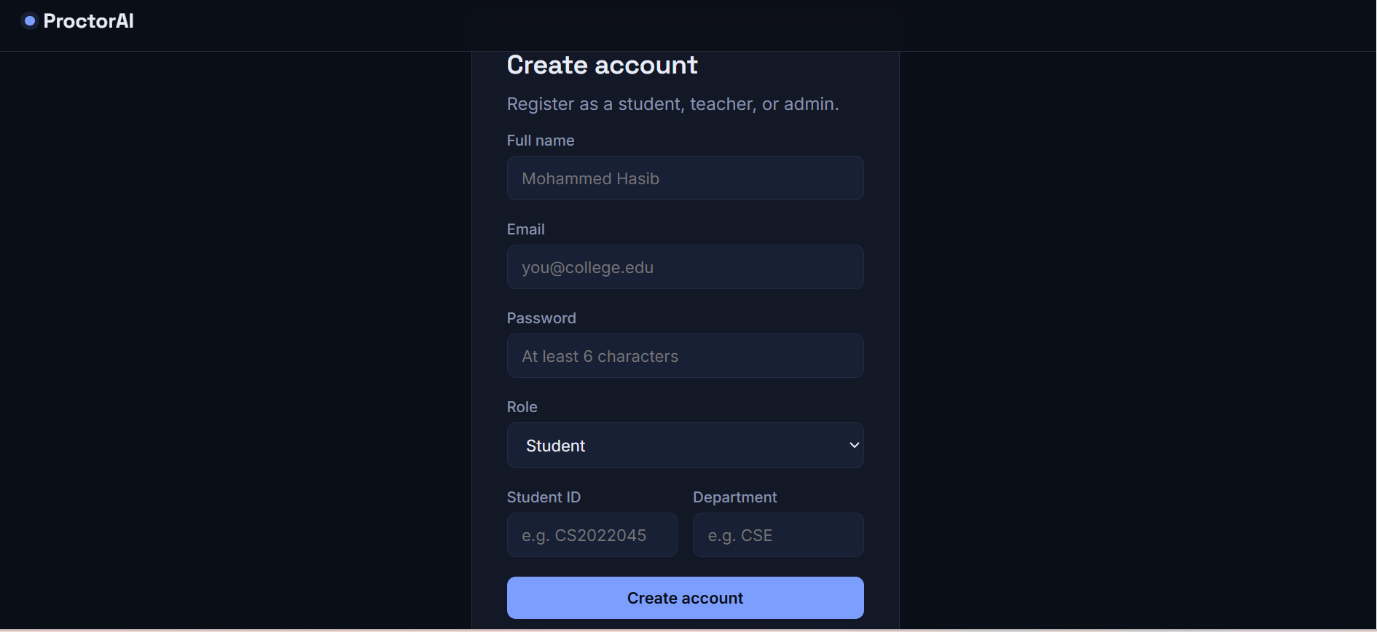
Snippet 1:- Registration Interface.
This screen provides the account creation and registration interface for the ProctorAI system. A new user can enter their full name, email address, password, and select the appropriate role, such as Student or Teacher. For student registration, additional details such as Student ID and Department are collected. The “Create account” button submits the registration details and creates the user account. This interface establishes the user’s identity and role before they access the examination system.
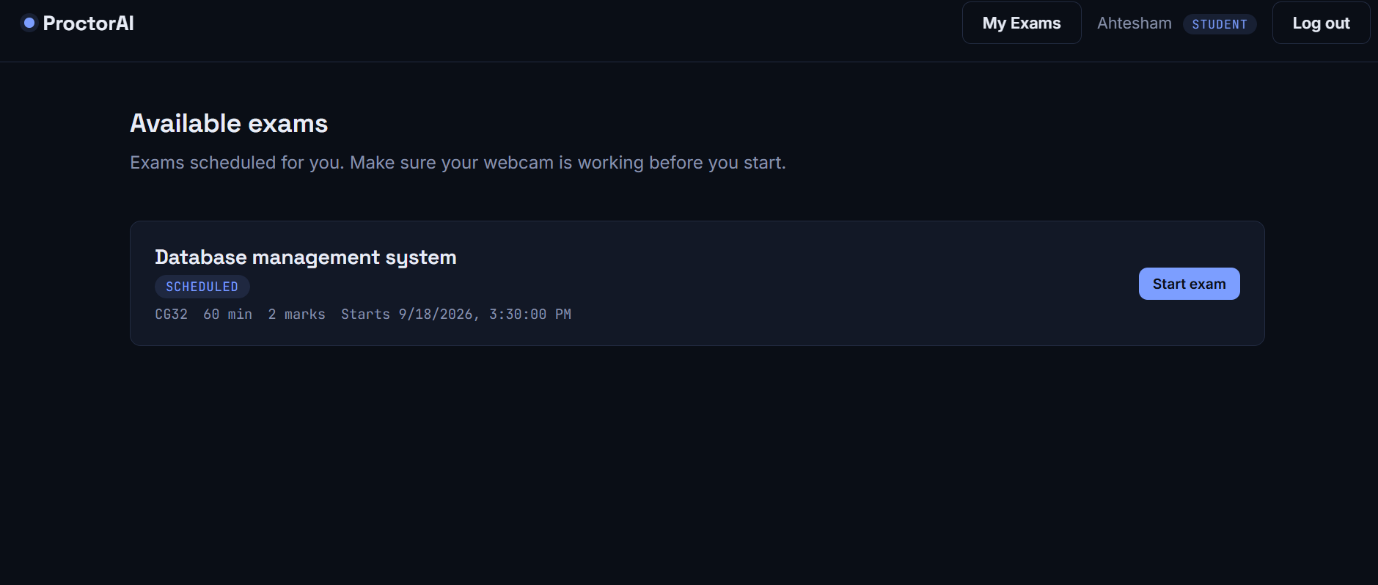
Snippet 2:- Student Available Exams Interface.
This screen presents the examinations assigned or scheduled for a particular student. Each examination displays information such as the exam name, course/code, duration, total marks, scheduled date and time, and its current status. The “Start exam” button allows the student to access an examination when it becomes available.
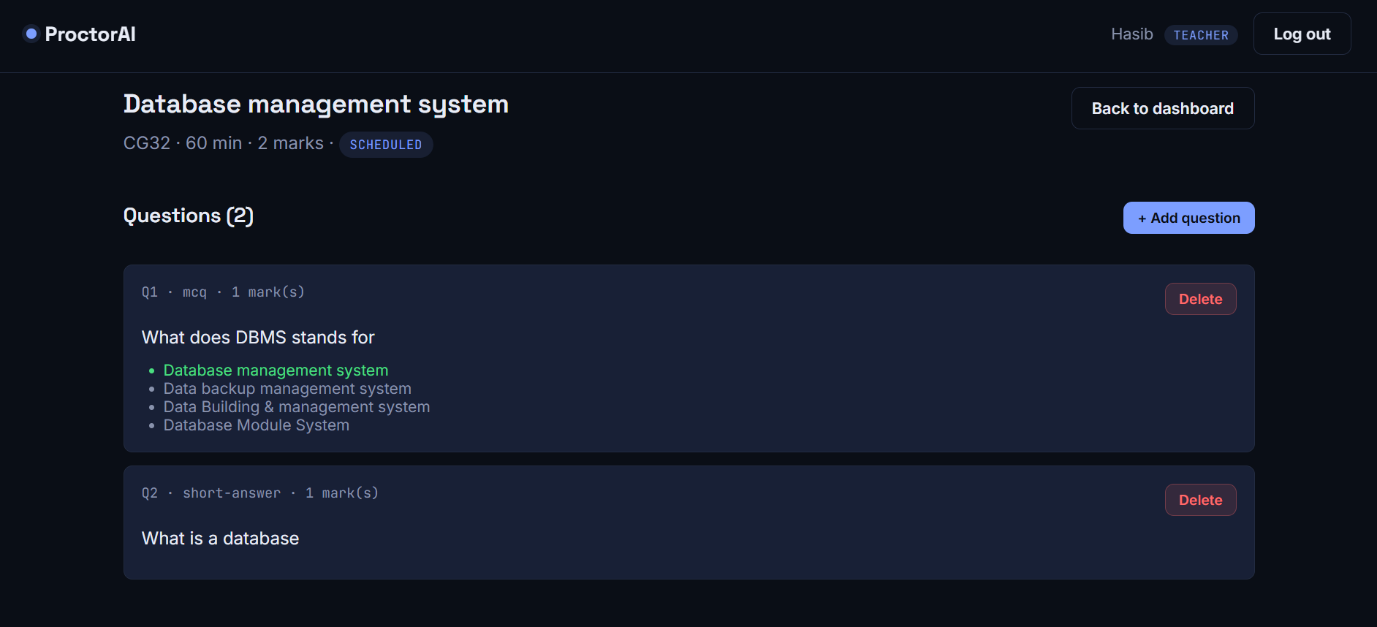
Snippet 3:- Teacher Question Management Interface.
This interface allows the teacher to manage the questions associated with an examination. The teacher can view the total number of questions, question types, marks, correct answers, and available options. A new question can be added using the “Add question” option, while existing questions can be removed using the “Delete” button. This provides basic examination-content management within the system.
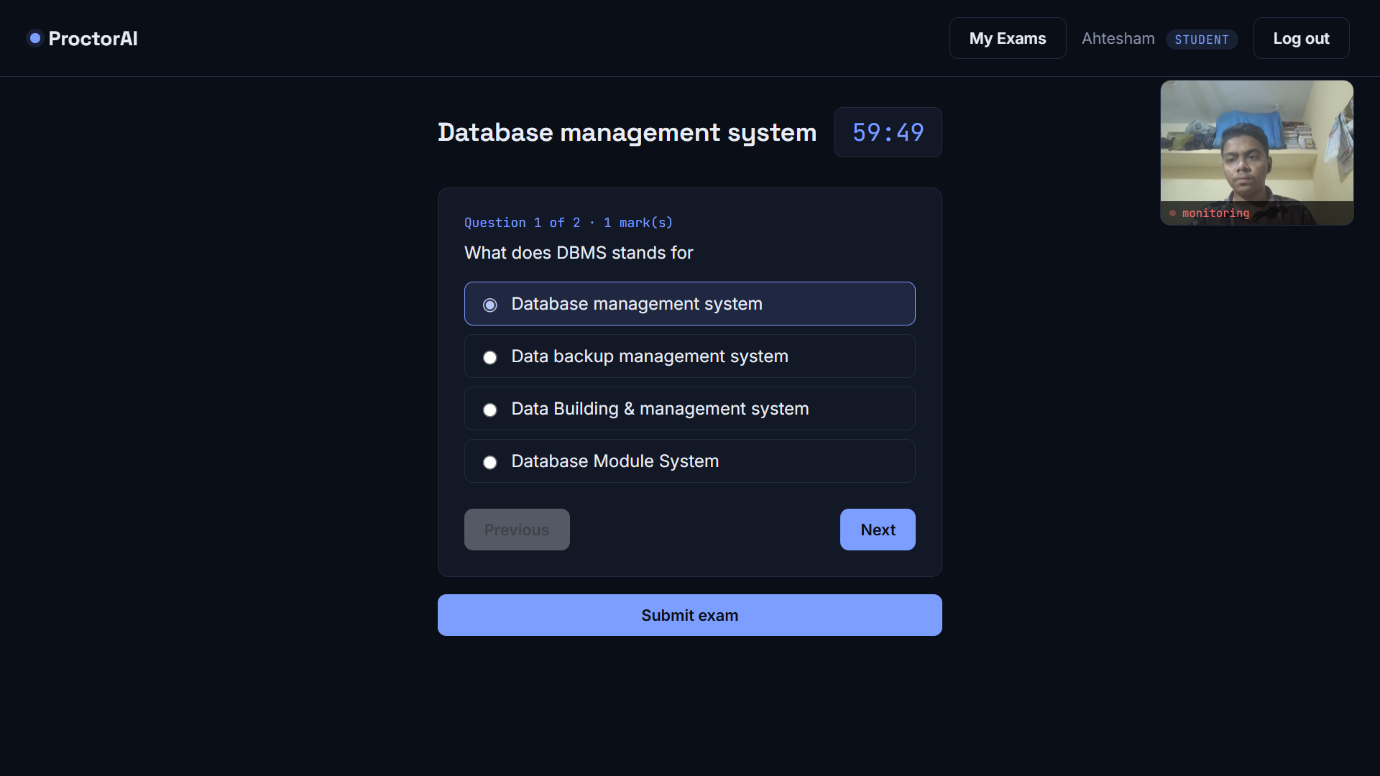
Snippet 4:- Student Examination Interface.
This screen shows the main examination interface for the student. It displays the exam title, remaining time, question number, marks, multiple-choice options, and navigation controls. A live webcam feed is also visible in the upper-right corner for examination monitoring. The student can move between questions and finally submit the examination through the “Submit exam” button.
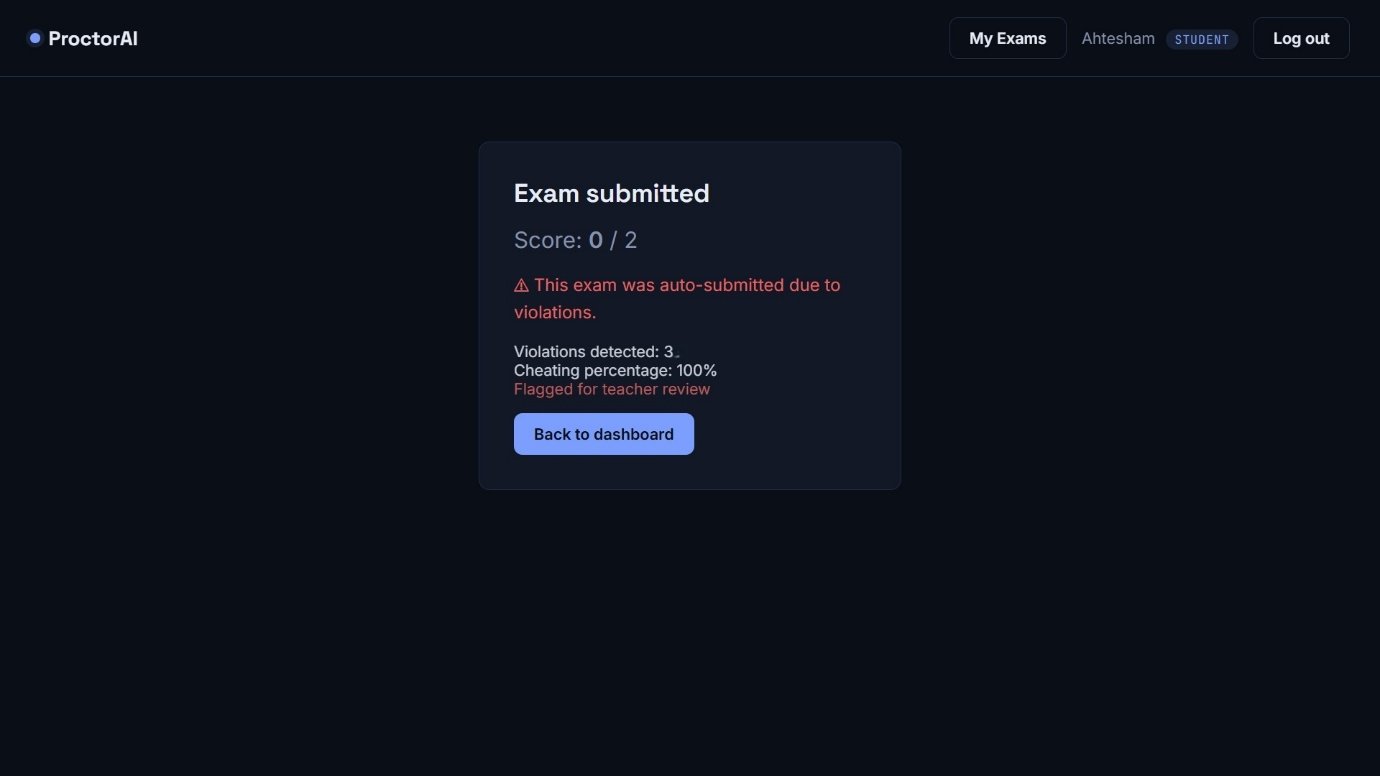
Snippet 5:- Examination Submission and Violation Report.
This screen displays the final status of the student’s examination after submission. It shows the obtained score along with the number of detected violations during the examination. If the configured violation threshold is exceeded, the system can automatically submit the examination and mark it for teacher review. The interface also presents the calculated cheating percentage and indicates that the attempt has been flagged. This provides an immediate summary of the examination outcome and the detected proctoring events before returning the student to the dashboard.
6. Conclusion and Future Scope
This paper presented an AI-Based Online Exam Proctoring System that integrates role-based exam management with a lightweight, browser-native proctoring layer capable of real-time violation detection, weighted cheating-percentage scoring, automatic grading, and threshold-based auto-submission, all within a single self-hosted MERN-stack application. Unlike the majority of systems identified in the literature survey, which isolate a single detection modality and often stop at the research-prototype stage, the proposed system was implemented as a complete, end-to-end platform and validated through ten passing functional test cases spanning authentication, exam authoring, live proctoring, scoring, and reporting. The result is a practical, low-cost proctoring solution suitable for deployment by colleges that cannot justify the licensing cost of commercial proctoring services, while remaining fully open to modification and extension.
Future work will focus on closing the gap between the current rule-based detection layer and the computer-vision capabilities demonstrated in the literature. Planned enhancements include integrating a lightweight in-browser face-detection model to verify continuous single-face presence and flag multiple-face or no-face scenarios; adding gaze-direction estimation to detect sustained off-screen reading; incorporating audio-anomaly detection to flag whispering or multiple voices; extending auto-grading to short-answer questions using semantic similarity scoring rather than exact string matching; exploring blockchain-based result storage to make final scores tamper-evident; and packaging the system for cloud deployment with horizontal scaling to support larger student cohorts. Together, these enhancements would move the system from a rule-based proctoring platform toward a hybrid AI-assisted proctoring system without sacrificing the low deployment cost that is its central design contribution.